 Cloud Agent Lab
Requirements Analyst
WorkingReads a plain-language request and returns structured requirements, each with a priority, plus service dependencies, risks and open questions.
Output: requirements.json
Multi-agent system
Each agent has one job, a defined input and output, and access only to the tools that job needs. They pass structured JSON to each other, and every output is validated before the next agent uses it.
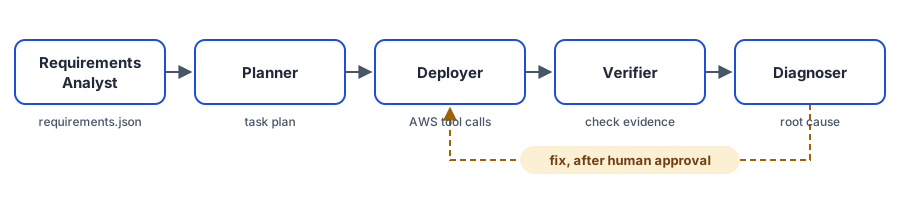
Reads a plain-language request and returns structured requirements, each with a priority, plus service dependencies, risks and open questions.
Output: requirements.json
Turns the requirements into an ordered list of deployment tasks, each mapped to an approved tool and its arguments.
Output: task plan
Executes planned tasks through an allowlist of deployment tools: certificate, bucket, CloudFront and DNS steps. Changes that could break the site wait for human approval.
Tools: AWS SDK for Python
Tests the live site: HTTPS, the HTTP redirect, certificate names, every page, CloudFront delivery and denied direct S3 access. Records status codes and headers as evidence.
Output: check results
Reads failed checks with the current configuration, identifies the likely root cause, and proposes a specific fix for a person to approve.
Output: proposed corrective action